

Buying a vehicle from South Africa while you are in another country involves sending a significant amount of money to a seller you may never meet in person. That dynamic, large sums, remote transactions, and urgency, is exactly what vehicle export scammers rely on.
Fraud in the vehicle market is not a small or occasional problem. South Africa’s banks have issued repeated warnings about a sharp rise in vehicle purchase scams across digital platforms. According to a 2025 report by the Global Anti-Scam Alliance, 77 percent of South Africans encountered a scam in the preceding 12 months. The vehicle sector is among the most actively targeted, with fake listings, cloned websites, and impersonation of legitimate companies all confirmed and documented by industry bodies including the South African Institute of Auctioneers and major banks such as WesBank and Standard Bank.
For buyers outside South Africa, the risk is even higher. You cannot physically visit a seller. You cannot inspect the vehicle yourself without a trusted representative on the ground. You are relying on documentation, photographs, and communication, all of which can be fabricated.
This guide explains how vehicle export scams work, what the documented red flags are, how to verify a legitimate exporter, and what a safe buying process looks like from start to finish.
Why Buyers Outside South Africa Are Specifically Targeted
Scammers follow the path of least resistance. Cross-border buyers are attractive targets for several reasons that have nothing to do with intelligence or caution.
Distance removes the ability to physically inspect a vehicle before paying. This creates a natural window for misrepresentation. A buyer in Nairobi or Dar es Salaam cannot drive to Johannesburg to verify a car they found on a website or in a WhatsApp message.
Urgency is easier to manufacture remotely. A seller who says “three other buyers are interested, you need to pay a deposit today” can apply that pressure without any accountability. There is no face-to-face meeting where a buyer can gauge credibility.
Wire transfers and international bank payments are largely irreversible. Unlike a cash transaction in person, once a cross-border payment leaves your account, recovering it when things go wrong is extremely difficult and often impossible.
Legitimate export compliance is complex enough that many buyers do not know which steps are real requirements and which are fabricated by scammers. A fraudster who invents a “clearance fee” or “customs deposit” can sound credible to a first-time importer who has no reference point.
The Most Common Vehicle Export Scam Types
Understanding how scams are structured helps you recognise them before money changes hands. The following are documented patterns reported by South African industry bodies, financial institutions, and consumer protection authorities.
The Ghost Vehicle Listing
This is the most common and most costly scam for cross-border buyers. A vehicle, usually a popular model like a Toyota Hilux, Land Cruiser, or Ford Ranger, is advertised at a price noticeably below market value. The listing includes real-looking photographs, often scraped from legitimate dealer websites, and a compelling backstory: the seller is emigrating, has a family emergency, or needs to sell quickly to settle a debt.
The buyer is asked to pay a deposit or the full amount to “secure” the vehicle. Once the payment is made, the seller disappears. There is no vehicle. There is no seller at that address. The money is gone.
The South African Institute of Auctioneers confirmed in 2025 that scammers create fake websites and advertisements that mimic legitimate sellers, with stolen branding, official-looking WhatsApp business accounts, and email signatures designed to appear credible.
The red flag: A price significantly below what comparable vehicles are selling for on verified platforms like AutoTrader South Africa. Any seller creating urgency around payment without allowing inspection first.
The Fake Export Company Website
This scam targets buyers specifically looking for a South African vehicle exporter online. A fraudulent company creates a professional-looking website with invented testimonials, fabricated certifications, and sometimes stolen imagery from legitimate businesses. They may even use a name similar to a known exporter to create confusion.
The buyer engages, receives quotes, and eventually transfers money for a vehicle, documentation fees, or shipping costs. The vehicle is never processed. The company either vanishes or continues collecting money through invented delay explanations.
The red flag: A company with no physical address, no verifiable phone number, no registration details, and no history that predates recent months. Websites can be created in an hour. Check when the domain was registered.
The Impersonation Scam
Documented and confirmed by WesBank in 2025: fraudsters create fake social media accounts and WhatsApp business profiles using the branding, logos, and even employee names of legitimate financial institutions, auction houses, or export companies. They advertise vehicles at below-market prices and collect deposits for vehicles that do not exist or are not theirs to sell.
The sophistication of these impersonations has increased significantly. Cloned websites that visually replicate a legitimate business down to specific page layouts are now common. The only difference is the bank account details provided for payment.
The red flag: Any vehicle offer received through social media, WhatsApp groups, or TikTok that you did not seek out by visiting a verified company website directly. WesBank has explicitly stated they do not sell vehicles outside official auction channels.
The Outstanding Finance Vehicle
This scam involves a seller who legitimately owns and can show you a real vehicle, but the vehicle has outstanding finance registered against it. The buyer pays, takes possession, and later discovers through a VIN check or at a border crossing that the vehicle is flagged as security for an unpaid loan. In South Africa, this means the finance company has a legal claim on the vehicle regardless of the sale. The vehicle can be repossessed even after you have paid in full.
This is not always a deliberate scam. Some sellers genuinely do not understand the legal implications. But the outcome for the buyer is the same.
The red flag: Any seller who is unwilling or unable to provide a clearance letter from the finance institution confirming the vehicle is unencumbered before payment.
The Odometer Fraud Vehicle
A vehicle’s mileage is turned back to show a lower reading than actual, allowing the seller to price it higher than its true condition justifies. On modern vehicles with digital odometers this is harder than it once was, but the practice continues. Indicators include wear on pedal rubbers, seat fabric, and steering wheel that does not match the stated mileage, or a service history with suspiciously low kilometre intervals.
The red flag: Mileage that seems inconsistent with the vehicle’s age and condition. A service book where the kilometre stamps do not follow a logical progression.
The Advance Fee Scam
After an initial transaction or even before any purchase, a buyer is told there is an unexpected fee required to release the vehicle, clear customs, or process documentation. The fee is presented as official, urgent, and necessary. Once paid, another fee appears. This cycle continues until the buyer stops paying or the scammer disappears.
Legitimate export processes do have real costs, which is exactly what makes this scam effective. Police clearance, SARPCCO clearance, export documentation, and shipping all cost money. The scam layers fabricated fees on top of these real ones, relying on the buyer not knowing which fees are genuine.
The red flag: Any fee requested outside of a documented, itemised quote agreed before the process begins. Any fee described as urgent and unplanned that must be paid immediately to avoid losing the vehicle.
The 10 Red Flags Every Buyer Must Know
Based on documented patterns from South African industry bodies, financial institutions, and consumer protection authorities, these are the specific warning signs to watch for:
- Price significantly below market value. Compare the asking price to verified listings on AutoTrader South Africa or Cars.co.za. A Toyota Hilux double cab 4×4 from 2022 has a known market range. An offer that falls substantially below that range without a clear explanation is a warning sign.
- Urgency pressure. “Pay today or lose the vehicle.” “Three other buyers are waiting.” Legitimate sellers do not manufacture artificial deadlines. Urgency is a documented manipulation tactic used consistently across scam types.
- No verifiable physical presence. A legitimate South African export company has a physical address, a landline number, and provable history. If a search for the company name returns only a recently created website and a WhatsApp number, stop.
- Requests for payment through informal channels. Payment via Western Union, informal money transfer services, or personal accounts rather than a registered business account is a documented red flag. Legitimate exporters receive payment to business accounts with verifiable company names.
- Refusal or inability to allow physical inspection. Any seller who cannot facilitate an independent inspection of the vehicle before payment has something to hide. In South Africa, physical inspection before export is standard practice for legitimate transactions.
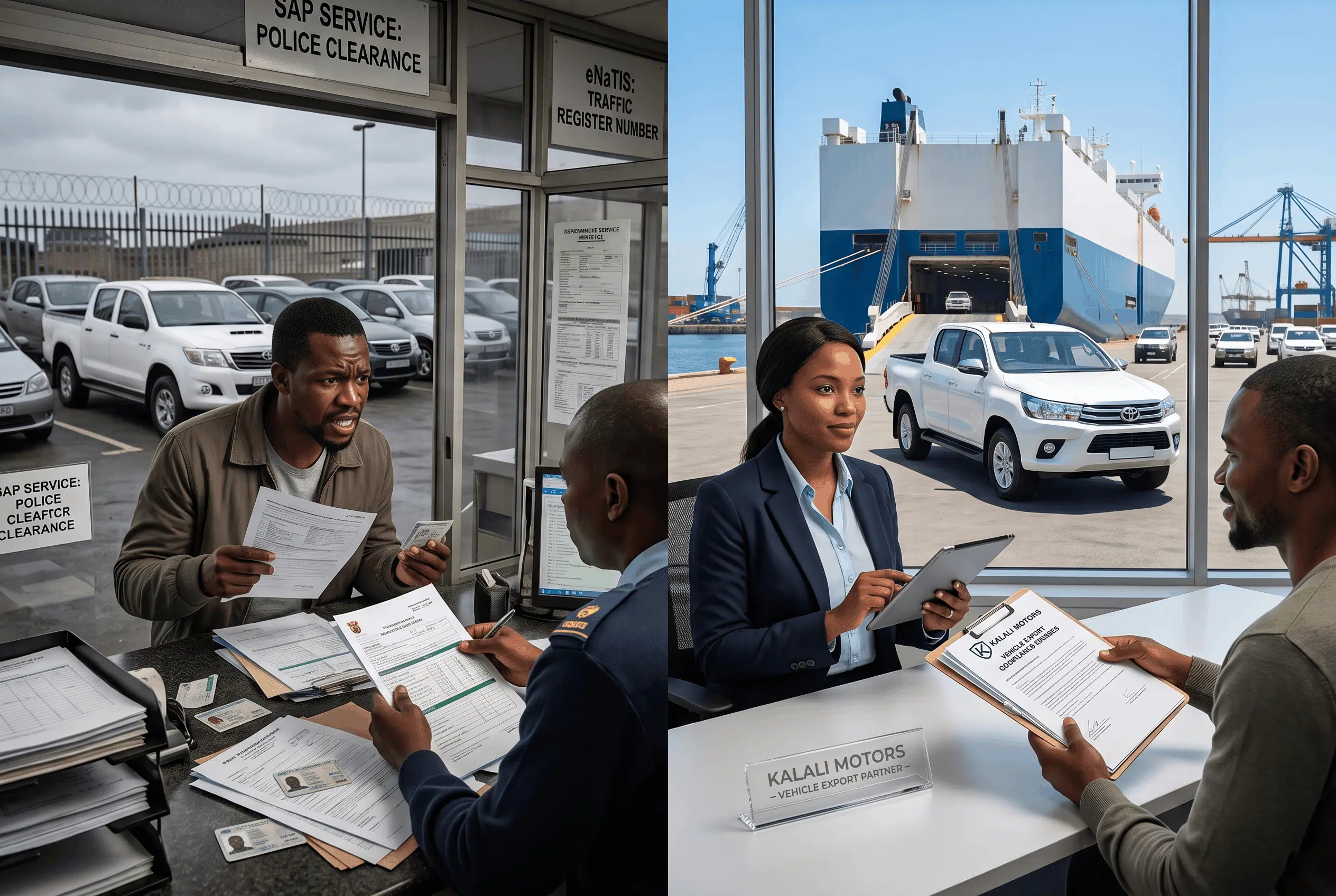
- No police clearance documentation offered. Every vehicle leaving South Africa legally must pass South African Police Service clearance. A seller who cannot explain this process or provide confirmation that it will be completed has not processed legitimate exports before.
- Documentation inconsistencies. VIN numbers on physical components should match registration documents. If they do not match, the vehicle may be stolen or fraudulently registered.
- Communication only through messaging apps. Legitimate companies have email addresses on registered domains, not Gmail or Hotmail. They have trackable phone numbers. A seller who insists on WhatsApp-only communication is limiting their accountability.
- Invented fees after payment. As described above, any unplanned fee that appears after an initial payment and is described as urgent and necessary to proceed is a strong indicator of an advance fee scam.
- No clear company registration details. In South Africa, registered companies have a company registration number from the Companies and Intellectual Property Commission. A legitimate exporter can provide this on request.
How to Verify a Legitimate South African Vehicle Exporter
Knowing the red flags is one side of the equation. Knowing what a legitimate exporter looks like is the other.
Verifiable physical presence. A legitimate South African vehicle exporter has a physical address that can be verified on Google Maps, a landline number, and a business email on a registered domain. They can be found through independent searches that predate your inquiry.
Company registration. Registered South African businesses have a registration number issued by the Companies and Intellectual Property Commission, known as CIPC. This can be verified on the CIPC website. If a company cannot provide a registration number or if the number does not match when checked, that is a serious concern.
Clear process documentation. A legitimate exporter can explain every stage of the export process in detail: police clearance, SARPCCO clearance for SADC destinations, export documentation, and shipping. They can provide documentation at each stage. If an exporter cannot explain what SARPCCO clearance is or why police clearance is required, they have not done this before.
You can read about what legitimate export compliance looks like in practice here: Documents Required to Export a Car from South Africa
References and verifiable reviews. Testimonials on a company’s own website are easy to fabricate. Look for references that exist independently, such as reviews on Google Business Profile, mentions on third-party sites, or referrals from buyers in your own network who have completed real transactions.
Transparent cost breakdown. A professional exporter provides an itemised quote that covers vehicle cost, export documentation, police clearance, shipping, and any other applicable fees before the process begins. Costs do not appear unexpectedly after payment.
Willingness to allow inspection. A legitimate exporter welcomes independent inspection of the vehicle before payment. They are not threatened by it because the vehicle is real and its condition matches the description.
What a Safe South Africa Vehicle Import Process Actually Looks Like
For comparison, here is what the process looks like when it is handled correctly and legitimately.
The buyer identifies a vehicle and specifies requirements including model, year, engine, and budget. The exporter sources matching options from verified dealer or supplier inventory, not from unverifiable private listings.
Before any payment, the buyer or their representative can request physical inspection. The exporter facilitates access.
A written, itemised quote is provided covering all costs. Payment goes to a registered company business account with the company name visible.
Police clearance is applied for through the South African Police Service. This is a traceable, documented process that takes between three and seven working days.
For SADC-bound vehicles, SARPCCO clearance follows. This is explained in detail here: Complete Guide to SARPCCO Clearance for Vehicle Export from South Africa
Export documentation is prepared and provided to the buyer. Shipping is booked and the buyer receives a bill of lading and tracking information. The complete export process is explained step by step here: Export Procedure
No stage of this process involves unexpected fees, WhatsApp-only communication, or urgency pressure. Each step has documentation that can be verified.
Specific Advice for Buyers in Tanzania, Kenya, Zimbabwe and Zambia
Buyers across these markets share common vulnerabilities that scammers exploit.
In Tanzania and Kenya, buyers importing for the first time may not know the specific documentation requirements at the destination port. Scammers exploit this by inventing “port release fees” or “customs deposits” that must be paid before the vehicle can be cleared. These do not exist as informal payments. Port and customs charges in both countries are formal, documented, and paid to official authorities.
Country-specific guides covering exactly what is required and what costs are legitimate at each destination are available here:
- How to Import a Car from South Africa to Tanzania
- How to Import a Car from South Africa to Kenya
- How to Import a Car from South Africa to Zimbabwe
- How to Import a Car from South Africa to Zambia
In Zimbabwe and Zambia, road transport is common for vehicle imports from South Africa. This creates an additional risk point: vehicles transported by road must be properly documented at each border crossing. A vehicle without valid export documentation, police clearance, and SARPCCO clearance will be held at the border, sometimes indefinitely. Understanding what documentation is required before shipment is the most effective protection against this type of delay.
Safe Buying Checklist
Before committing to any South Africa vehicle purchase for export, work through this checklist:
Seller verification
- Company name returns a history in independent searches that predates your inquiry
- Physical address is verifiable and not a residential property or PO box
- Company registration number can be verified on the CIPC website
- A landline or business phone number is provided and answered during business hours
- Email communication uses a registered company domain
Vehicle verification
- VIN number can be verified on the eNaTIS or through a registered South African VIN check service
- No outstanding finance confirmed through a finance clearance check
- Physical inspection by an independent party is available before payment
- Service history is documented and consistent with the stated mileage
- Vehicle year and registration match the stated age
Transaction safety
- Full itemised cost quote provided in writing before any payment
- Payment goes to a registered company business account, not a personal account
- No informal payment channels such as Western Union, mobile money to a personal number, or cash requested
- No urgency pressure to pay before completing verification steps
- Police clearance and export documentation are explained and can be confirmed
Process confirmation
- Exporter can explain the police clearance process and approximate timeline
- Exporter confirms SARPCCO clearance for SADC destinations
- Shipping confirmation and bill of lading will be provided before vessel departure
- Communication is available through more than one channel
How Kalali Motors Handles the Process
Kalali Motors sources vehicles from a network of over 6,000 verified suppliers across South Africa, including registered Toyota dealerships, certified pre-owned programs, and established independent dealers. This means inventory is sourced from accountable sellers with paper trails, not from private listings where verification is impossible.
Every vehicle goes through police clearance before export. SARPCCO clearance is handled for SADC-bound vehicles. Export documentation is prepared by the team and provided to the buyer at each stage.
Jubilate Lema, the managing director, has years of experience in cross-border vehicle export across Southern and East Africa. The company operates with verifiable office contacts in South Africa, Tanzania, and Zimbabwe.
If you have concerns about a specific seller, want to verify whether an offer you have received appears legitimate, or want to understand what a proper quote for your specific vehicle and destination should include, the team is available to assist: Contact Kalali Motors
You can also read about the full range of export services here: Export Paperwork and Compliance
For context on what makes South Africa a credible and structured sourcing market compared to alternatives, this page provides a useful overview: Why South Africa
Check that the company has a verifiable physical address, a CIPC company registration number, a business email on a registered domain, and a history that predates your inquiry. A legitimate exporter can explain the police clearance and SARPCCO process in detail, provides itemised quotes in writing, and facilitates independent vehicle inspection before payment. If any of these elements are missing or evasive, that is a warning sign.
The most documented red flags are a price significantly below market value for the same model, urgency pressure to pay before inspection, requests for payment through informal channels such as Western Union or personal bank accounts, communication limited to WhatsApp only, and fees that appear unexpectedly after an initial payment. Any one of these on its own warrants serious caution.
No. Every vehicle leaving South Africa for export must pass a South African Police Service inspection. This is a legal requirement without exception. Any seller claiming a vehicle can be exported without police clearance is either misinformed or attempting fraud.
The finance institution holds a legal claim on the vehicle regardless of the subsequent sale. If the loan is not repaid, the finance company can repossess the vehicle even if it has been legally exported. Always request a written clearance letter confirming no outstanding finance before committing to payment.
Only if you have verified the company is legitimate, received an itemised quote in writing, and the payment goes to a registered business account. Never pay a deposit based solely on a WhatsApp conversation, a social media advertisement, or an offer that appeared without you seeking out the company directly. As WesBank and the South African Institute of Auctioneers have both confirmed publicly, fraudsters routinely collect deposits for vehicles that do not exist.
The VIN appears in multiple locations on the vehicle: the dashboard visible through the windscreen, the door jamb sticker, and the engine bay. These should all match. The VIN can be checked against the eNaTIS system for registration history. A mismatched or absent VIN is a serious warning sign. A reputable exporter facilitates this check as part of the standard pre-purchase process.